










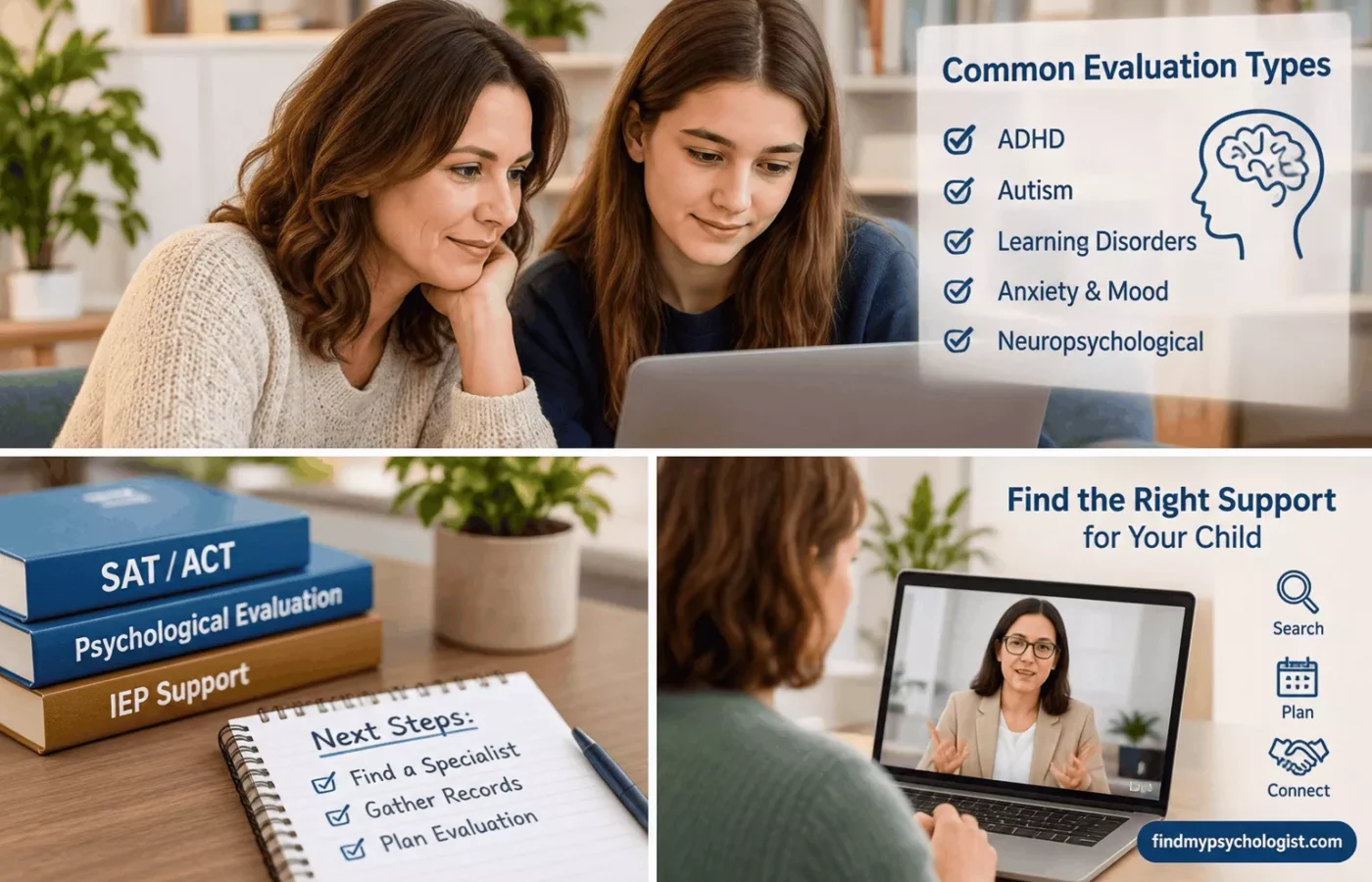
When a family asks where to go for testing, the first question is usually what kind of evaluation they need. This page is meant to be printed and kept as a general resource to help provide guidance for evaluations. Training and scope vary by professional and by state, so families should always ask an evaluator directly what they do.
Common evaluation types
| Evaluation type | What it usually looks at | Who typically does it |
| Psychoeducational or learning | Reading, writing, math, and the thinking skills behind them; possible learning disorders | Licensed psychologists; school psychologists for school-based evaluations |
| ADHD | Attention, impulsivity, and executive functioning across settings | Psychologists and neuropsychologists; pediatricians and psychiatrists may also assess and diagnose ADHD |
| Autism (children) | Social communication, play, and restricted or repetitive behaviors | Psychologists, developmental-behavioral pediatricians, child psychiatrists, and multidisciplinary teams |
| Autism (adults) | Social communication and lifelong developmental history | Psychologists and neuropsychologists who specifically evaluate adults |
| Neuropsychological | Memory, attention, language, processing speed, and other brain-behavior relationships, often with a medical or neurological history | Neuropsychologists (psychologists with specialized training) |
| Gifted or twice-exceptional | Advanced ability alongside any learning or attention differences | Psychologists; school psychologists for district gifted identification |
| Diagnostic or emotional | Mood, anxiety, personality, and diagnostic questions | Clinical psychologists |
| Forensic | Questions raised in legal cases, such as custody or competency | Psychologists with forensic training |
| Early childhood developmental | Development in very young children, including language, motor, and social skills | Psychologists, developmental-behavioral pediatricians, and early intervention teams for children under 3 [VERIFY] |
A note on school evaluations
Public schools evaluate students who may need special education services, at no cost to the family, and parents can ask the school to evaluate. A school evaluation answers whether a student qualifies for services at school. A private evaluation can answer a broader set of questions, including diagnosis. Some families need one, some need the other, and many use both.
Questions families can ask any evaluator
- Do you evaluate this specific concern, at this age?
- How many appointments does it take, and when will we get the report?
- Do you take our insurance, or provide a superbill?
- Can any part of it be done by telehealth?
Share Find My Psychologist
Find My Psychologist is a directory built only for psychologists who do evaluations and testing. Families can search by evaluation type and see who offers telehealth, including across state lines through PSYPACT. Please share findmypsychologist.com with patients and families who need an evaluation.